


Bōsōzoku (暴走族) – Legacy of Thunder
- Marvin
- Feb 1
- 8 min read
We frequently use terms like 'JDM' without a second thought, but what truly defines this subculture and where do its roots lie?
Time and again, I hear people at events throwing around terms they don’t seem to understand themselves. After all, not everyone has the motivation to translate thirty- or forty-year-old magazines or twenty-year-old websites just to gather knowledge about authentic tuning. For 15 years now, I have focused primarily on Japanese tuning culture, and yet I am constantly learning new things and that is exactly what this is about: categorizing terms, explaining origins, and making authentic tuning understandable.
To do this, we first look at the beginnings of tuning in global car culture. For as long as cars have existed, people have been tinkering with and personalizing them to reflect their own character and desires. This is not a phenomenon limited to one continent, but one that is popular worldwide.

We’re starting in the 1970s to even begin to grasp the sheer, almost biblical proportions of the tuning world. In America, the car world is booming-muscle cars, vans, trucks, motorcycles. Everything with wheels is being modified. The younger generations in particular felt drawn to tuning and, without knowing it, left a lasting mark on tuning culture. Cars were built for drag racing, hot rods cruised through the city, and surfers converted cheap vans into surf vans with flashy paint jobs and wild interiors. All of this reached Japan as the "American Dream." This is how almost all the tuning styles we will encounter in this format came to be.


In Japan people yearned for personal expression and a balance to the strict working life in a culture full of norms and etiquette. Discharged kamikaze pilots formed rebellious gangs, while young people wanted to bring the American Dream to Japan.
The most famous and equally often misused term, "Bōsōzoku" (暴走族), serves as our entry point into the world of authentic JDM. Building on this, we will explore the evolution of today's tuning scene chronologically. This covers the full spectrum of cars (Kaido Racer, Kanjozuku, etc.) as well as motorcycles (Bōsōzoku), trucks (Dekotora), and 50cc scooters (Gentsuki Kyu).


September 1945 - World War II ended with the signing of the surrender treaty on the American battleship USS Missouri, marking the end for Japan as well. A nation breathed a sigh of relief and began the structural reconstruction of the country. The population was exhausted but relieved, yet not everyone managed the path back to a normal life. Thus, the once celebrated Kamikaze pilots became outsiders. But who were these Kamikaze pilots and what was their role in the war? To understand that, we have to look at Japan’s situation during the war. The nation was at its breaking point - more and more soldiers were dying during the brutal American attacks. All that remained were young men aged 15-20, who were often pushed into Kamikaze units by society and had long since made peace with their own death. The sole purpose of these units was to destroy enemy warships through suicide attacks. So, what happened to teenagers who had envisioned no future life, attended no school, and were now left behind?


This is how the “First Generation” of the Bōsōzoku was born. It was these very teenagers who banded together, bought cheap motorcycles, and modified them to be as loud as possible. On these self built machines from hell, they raced through the streets of Japan in formation. It didn't take long for the media to give them a name - "Kaminari-Zoku" (Lightning Tribe). At the time, they were still a peaceful, though socially annoying, group of teenagers on motorcycles, but that would change rapidly over time.

In the early 1970s, a new generation took over the streets. A generation that joined the Kaminari Zoku out of pure rebellion and a lack of prospects to voice their frustration toward society. With this “second generation”, the readiness for violence increased, causing the media to focus even more heavily on these gangs. Soon, a new, more fitting name emerged - "Bōsōzoku" (Violent Running Tribe). This name resulted from increasingly frequent reports of attacks on police officers and rival gangs with baseball bats or knives. The average age dropped rapidly due to the massive influx of teenagers aged 15-20, who were often school dropouts, rebels, or even homeless. The violence of these teenagers was gruesome. A former leader of the gang "Specter" reported in a 2015 VICE documentary about how members of rival gangs were kidnapped, chained to cars, and dragged through the streets. To their death.
This is where the first gaps in Japan's social system became apparent, as the age of majority and the associated criminal responsibility did not begin until age 20. Thus, objectively speaking, the Bōsōzoku consisted only of children who could not be prosecuted. Arrests resulted in harmless warnings and failed to intimidate the gangs. Deep insights into this era were provided by the first authentic documentary by Mitsuo Yanagimachi titled "God Speed You! Black Emperor." Anyone with a strong interest in the beginnings of the Bōsōzoku will find real insights into the subject matter here.
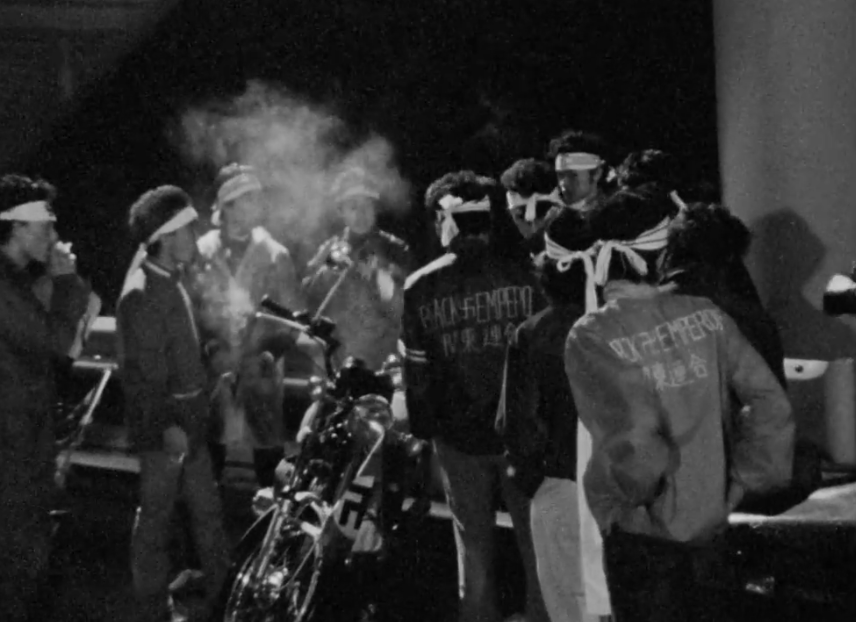
By the age of 20, many members of the Bōsōzoku faced an essential decision. Would they remain part of their gang and commit a criminal offense with every ride, or would they finally find their footing in society and leave their youthful recklessness behind? In most cases, these young men found their way into the Yakuza rather than an orderly life. What were once isolated cases reached its peak in the mid 1980s. Today, it is estimated that at that time, nearly a third of new Yakuza recruits had direct links to the Bōsōzoku. After all, they fit the typical Yakuza profile perfectly: dissatisfied with the social system, homeless, violent, and marginalized.

Around 1985, the Bōsōzoku reached the peak of their culture with approximately 42.500 members across well over 800 gangs. I don’t even want to imagine the kind of terror such gangs caused on the streets - especially when we look at the famous “Bōsō Drives”, which were intended solely to showcase the gangs presence and dominance. In record time, sometimes thousands of Bōsōzoku would gather through internal arrangements to ride together through cities and territories and spread chaos. Within these groups, clear hierarchies and rules prevailed: at the front rode the gang leader who organized the drive, often accompanied by cars to clear traffic. Behind him followed the gang's flag bearer, with all the members in between, and at the very end, experienced members tasked with slowing down and obstructing police cars. However, such “Bōsō Drives” were by no means unplanned rides through the city, but highly sophisticated routes that included strategic preparations such as roadblocks along the way or diversionary maneuvers against the police.

Now, let’s imagine a Honda CBX400R with a cut-off exhaust pipe, revving through its entire powerband. Over and over again. Motorcycles generally tend to be incredibly loud, but with modified exhaust systems, it is almost unbearable. That is exactly what you would hear during these rides. Naturally, not from a single motorcycle, but from thousands - a completely absurd thought to me. But because simply "bouncing off the rev limiter" sounds boring, they used the high revving nature of the machines and began to twist the throttle almost rhythmically at an insane pace. In combination with occasionally popping the clutch, this creates melodies known as "Cutting Calls." What was intended back then only to disturb and provoke Japanese society has today become a discipline for which there are dedicated events and championships in Japan.
What actually defined a gang member’s look? Let’s start with the clothing. Gang members wore what is called a Tokko-Fuku (Special Attack Uniform), a mix of workwear and Kamikaze pilot uniforms. Along with this, they wore a long overcoat embroidered with the gang’s logo, mottos like “Never give up!”, their region, and the member’s rank. Last but not least, right wing symbols could be found on many overcoats, intended to add further shock value. However, the groups were not known to have an actual connection to right wing politics.


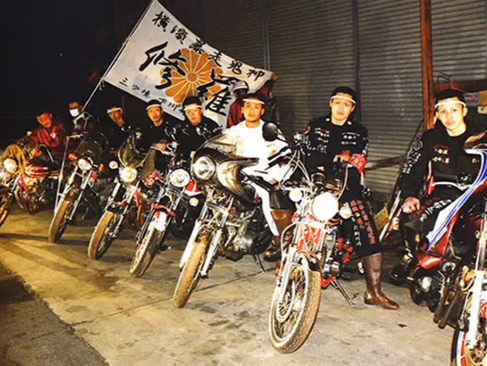
Surprisingly, since the second generation, it has no longer been about speed. It was mainly about noise, looks, and chaos, as we have learned from the "Bōsō Drives". To this day, the same base motorcycles are used for this purpose. These include the Honda CBX400F, Kawasaki Zephyr 400, and the Yamaha XJ 400. This leads us to the iconic modifications that fascinated me so much nearly a decade ago that I wanted to learn more about this culture.
Inspired by American films like "The Wild One" (1953) and, not least, British Café Racers, the Bōsōzoku adopted elements from both styles for their own creations. High rise handlebars bent inward, plastic front fairings, three tier seats with extended backrests, and spectacular paint jobs were the absolute standard. The ironic term "Devil’s Pipe" became a synonym for any type of exhaust modification intended solely to alter the volume. To remain as anonymous as possible, license plates were bent upward or mounted to swing freely. This made identification during a ride simply impossible. But if we’re honest, the license plate was just a drop in the ocean in this context, as the motorcycles were easily recognizable in their entirety. Gangs like "Specter" or "Black Emperor" always had consistent features such as eye catching gang stickers or full paint jobs in specific colors on their bikes. This was also true for the "Nina Mona" gang, which was considered the absolute spearhead of styling and shaped the development of Japanese tuning culture. Not least through well known names like Atsushi Muto, "Nina Mona" paved the way for our modern-day love of Japanese tuning. We will encounter Atsushi Muto's legendary "Muto Z" again in future articles on the subject of "Grachan".


During the late 1980s and early 1990s, however, the interests of Bōsōzoku members diverged noticeably. While one part of the membership continued to focus on their gang activities, a fascination with tuning grew within another part. It was exactly there that all the tuning styles, subcultures, and groups we know and love today originated. Whether it’s “Liberty Walk”, “Rocket Bunny”, or names like “Keiichi Tsuchiya”, they all, in both a direct and indirect sense, stem from the Bōsōzoku.
Today, all that remains is our glorified view of the past. Those who still ride such vehicles today are members of classic car and bike clubs and stand against the hierarchies and criminality of the past. However, the perception within Japan itself hasn't changed much. After decades of terror on the streets, society still views these vintage clubs critically: for instance, you can see very negative comments on social media platforms under videos of meetings, events, and runs by these clubs. Since the age of the internet and social media, information, images, and stories have spread much faster than before, causing fascination with this style to grow in other parts of the world as well. It’s not uncommon to see an increase in such motorcycle builds in the USA, Europe, or Japan's Asian neighboring countries. We also want to convert our 1980s Jaxson EX33II pocket bike into a Kaizosha. We will be documenting that process for a future article.
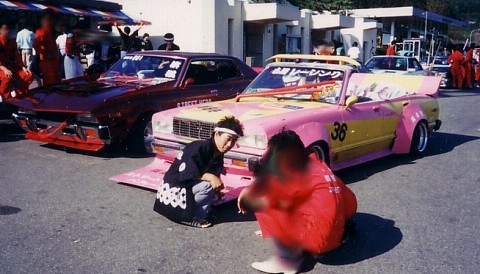
Finally, I’d like to say a word about cars in combination with the term “Bōsōzoku”. While Bōsōzoku cars did exist, it is no longer a term used for this type of vehicle. Due to the diverging interests of Bōsōzoku members over time, new terminology emerged for vehicles of this kind. So, while it’s not entirely wrong to use the term in this context, it’s not exactly right either.


https://jp.pinterest.com/pin/32791903525219109/
https://jp.pinterest.com/pin/3799980929126608/
https://jp.pinterest.com/pin/11259067813551443/
https://www.instagram.com/p/Cn3NnQMrUfp/?img_index=2
https://jp.pinterest.com/pin/941604234605446996/
https://www.nationalww2museum.org/war/articles/japans-kamikaze-pilots-wwii
https://history.howstuffworks.com/world-war-ii/japanese-kamikazes.htm
https://de.pinterest.com/pin/480407485229211624/
https://japanesenostalgiccar.com/boso-bikes-violent-running-tribe/
https://de.pinterest.com/pin/6825836929150670/
https://thegentlemanracer.com/2013/04/the-bosozoku-cars-of-japan/