


When style defies explanation
There are simply those people you happen to glance at, and your gaze instantly lingers.

Not because they are particularly loud or full of themselves, but because they possess an almost magnetic radiance. We are quick to speak of charisma or even aura, yet these terms don’t quite capture what they leave behind in a room. It is a presence, paired with a palpable honesty. What I once thought had no name turned out to be Mabu (まぶ).
It should hardly come as a surprise that Japanese culture found such an enchanting word for it, considering that even the sunlight dancing through the treetops carries its own name - Komorebi.

Every now and then, I cross paths with people like this. Especially at our booth or while grabbing a coffee at Espresso GT in Berlin, you encounter truly unique, fascinating characters. And with them come cars that radiate that very same presence. But how is Mabu (まぶ) created? Can it even be put into words, and what exactly defines it?
While browsing through our archive of Holiday Auto magazines, an article from 1986 answered all these questions. And so, I eagerly began translating and writing this article, hoping to provide a clear explanation of such a profound concept and why Mabu (まぶ) translates so perfectly into car culture.
Why words lose their meaning
In our Western culture, the word "authentic" probably comes closest to the mentioned word Mabu, though it remains miles away from the actual meaning. Unfortunately, "authenticity" is such a chronically overused word that it could hardly feel more unauthentic.
But the perspective of the Japanese article brings more clarity. It describes lifestyle as something constantly evolving. It isn’t something that appears all at once, and you certainly can’t plan it. Style develops from everything you choose, use, and live in your everyday life. Such choices might be why you drive a Mazda RX-7, why your shift knob is made of aluminum, or whose merchandise you collect.
You often choose things in the moment, without a grand plan. It’s only in hindsight that it becomes clear how these decisions form a complete picture. The article places a particular emphasis on the purchase of brand name products. You rarely choose a brand to show off, but rather because it aligns with your own style. Ultimately, brands always sell a feeling - which makes this behavior perfectly relatable.
That is how I subconsciously fell in love with Honda, Suzuki, and Porsche. To this day, I can’t quite explain why. And yet, I hold onto it steadily: I drive my Del Sol and my Swift, I’m planning to buy a Suzuki X90, and I dream so intensely of my Porsche G-Model that I’ve long owned the matching keychain and other merchandise.
Mabu (まぶ) is not a style you can simply learn. It becomes even more difficult when you try to explain this feeling logically or describe it to others. For in doing so, it loses exactly what makes it what it is.
Chic Mahagoni Targa

When I shared my vision for my first car five years ago, a 1994 Honda CRX Del Sol in Granada Black Pearl, I was mostly met with resistance.
My inspirations, drawn from the world of 911s, mahogany details, and classic car influences, found very little understanding. Looking back, it hardly surprises me. You really don’t associate this quirky car with that kind of design concept.
But as the years passed, all the elements came together, and suddenly the vision I had been pursuing all along became visible. I’m still far from finished. But just as an apartment or a wardrobe evolves, so does a car. Since none of us are billionaires, most modifications are a matter of time. Snagging rare parts requires patience and the right connections. Yet, even now, I sit in my ‘Soleil’ filled with excitement, as she feels like an extension of myself. She fits me as naturally as my outfit, my home, or my lifestyle.
Does it spark joy?
Marie Kondō, a name many might recognize, is an organizing consultant from Japan. Her famous catchphrase, ‘Does it spark joy?’, suggests that we should only surround ourselves with things that trigger pure, honest happiness. Whether we simply look at these objects or actually use them doesn’t matter, as long as they bring us daily delight.
The 1986 article describes precisely this: your style emerges when you surround yourself with things that simply feel right to you. That is the essence of Mabu (まぶ). However, the moment you try to over-control your style, it ceases to be alive.
If you only run 'cool' wheels because they get approval everywhere, you’ll eventually feel that something isn’t quite right. But if you follow your own sense of style, you will find joy in it every single day. Even if you don't get a round of applause from everyone at the car meets.
But then, there are those people who tell you: 'I would never have done it that way myself - but it’s truly beautiful.' To me, that is the greatest, even if most unusual, compliment of them all.
When people and things click into place

Mabu (まぶ), as the article explains, can also change throughout one’s life. Just as people change, as our thinking evolves and experiences shape us, so our style evolves just as well.
But when people and things truly belong together, they effectively lock into one another.
That is a form of Mabu (まぶ). The man with a Japanese pompadour, standing next to you in traffic, blasting City Pop songs in his convertible - he’s a Mabu-type! Whether something is on trend or not doesn’t matter. All that counts is whether it fits the person and how they live it. But what exactly is it that makes a car feel like Mabu (まぶ)?
When does a car become Mabu (まぶ)?
The article in Holiday Auto Magazine begins by stating that a car is not automatically better just because it is technically more advanced. When things become too perfect, too smooth, and over optimized, they lose their warmth and personality. The charm vanishes. Of course, cars may have been more impractical in the past, but you felt them more deeply.
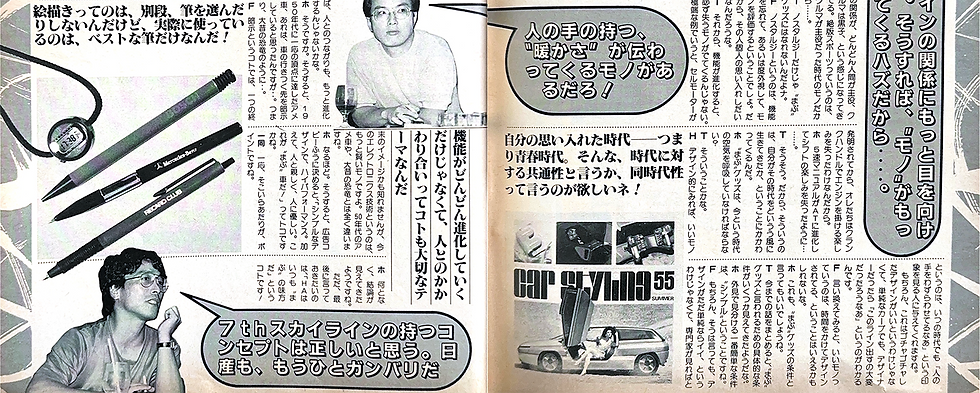
Then again, other cars simply feel as though they were created with genuine attention to the human being. The author emphasizes that this is not about rejecting technology or merely copying the past. Instead, he highlights the ‘soul’ of older technology, which was still fully and completely developed for people.
It is somewhat ironic that I should stumble upon this article exactly forty years later. For the criticisms made in 1986 could hardly be more applicable to the year 2026 - a year in which society yearns so deeply for the simplicity of the past that we carry old cameras and flip phones and watch our favorite shows on CRT televisions.
After the rapid technological developments of recent years, people are returning to things that feel as though they have a soul. Perhaps this is also why we, as a community, cling so tightly to the 80s and 90s.
It’s the vision of a somewhat simpler time - one where fewer entertainment options meant less of that palpable, everyday sensory overload. Whether that means being allowed to manually open the glove box in our classic car or simply being able to repair things ourselves.
In conclusion, it can be said that Mabu (まぶ) in cars is born where technology and feeling converge. A Mabu car is not a vehicle with the best specs, but one where you can sense it was made for human beings. And the same applies to tuning. Just because a car’s theoretical performance is convincing, or because it sticks to the asphalt thanks to its suspension, doesn't mean you’ll actually enjoy driving it every day.
If you want to drive your car every day, cruise down bumpy country roads into the sunset, and savor every single second, then don’t let anyone talk you into drastic, undrivable modifications. And if you see potential in an unpopular car, if you want to build and drive it from the heart, then don’t let anyone hold you back. Because true Mabu (まぶ) only happens when your passion is yours and yours alone.
Final Thoughts
The saying ‘beauty is in the eye of the beholder’ has taken on a whole new meaning for me through that article in Holiday Auto. I’ve realized why I can love something with all my heart while it leaves others cold - or why my decisions might seem irrational to outsiders, even though I wouldn't question them for a single second.
We shine brightest as human beings when we follow our Mabu (まぶ). It doesn’t matter if it defines how we live, how we dress, how we treat others, or what car we drive. Those who live by what they truly love feel a deep satisfaction and an inner peace that is hard to put into words.
It is exactly this mindset that creates Mabu (まぶ) in your own car. Not as a style, not as a statement, but as a genuine connection. This conviction gives us the courage to follow unconventional paths, to dive into niche subcultures, and to make style choices that simply feel right - even if they aren’t for everyone.
Especially in the age of social media, where so many believe their reality is a universal truth, Mabu (まぶ) serves as an essential lesson. Because our differences are the very reason why some people truly shine from within.
IMAGE CREDITS: